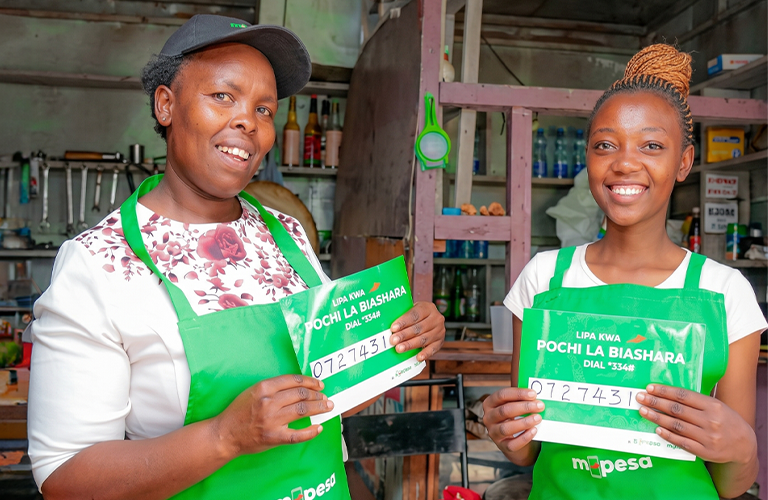
Pochi la Biashara Doubles Lipa na M-PESA Merchants Despite Fivefold Revenue Gap Per Business

Safaricom’s drive to deepen financial services among Kenya’s micro and small businesses has resulted in Pochi la Biashara growing to more than twice the size of Lipa na M-PESA in merchant numbers, although the platform continues to generate significantly less revenue than its formal merchant counterpart.
According to the Safaricom’s FY2026 audited financial results, Pochi la Biashara expanded to 2.1 million merchants, representing an 81.5 percent year-on-year increase, while Lipa na M-PESA reached 1.0 million formal merchants.
Combined, Safaricom’s merchant ecosystem grew 71 percent to approximately 3.1 million businesses, reinforcing M-PESA’s expanding role in Kenya’s digital commerce landscape.
However, despite its larger merchant base, Pochi la Biashara generated only KES 4.0 billion in revenue compared to KES 9.3 billion from Lipa na M-PESA.
Revenue per Merchant Highlights Difference between Informal and Formal Businesses
Based on FY2026 revenue, the average Pochi la Biashara merchant generated approximately KES 1,900 annually for Safaricom, while each Lipa na M-PESA merchant generated roughly KES 9,300, nearly five times higher.
Pochi la Biashara primarily serves informal traders, freelancers, home-based businesses and sole proprietors who process relatively smaller transaction volumes. Lipa na M-PESA, on the other hand, caters largely to registered retailers and businesses with higher transaction values and more established customer bases.
Nevertheless, Pochi la Biashara continued to outperform on growth, with revenue increasing 86 percent during FY2026 compared with 21.7 percent growth recorded by Lipa na M-PESA.
Safaricom Expands MSME Lending Through New Pochi Products
To accelerate adoption among small businesses, Safaricom introduced new credit products tailored for merchants operating within the M-PESA ecosystem.
The company launched Taasi Pochi, an unsecured loan facility offering eligible merchants access to financing of up to KES 150,000 without requiring physical collateral.
Merchants qualify after actively using Pochi la Biashara for more than six months and can apply through the MySafaricom App or by dialing *234#.
The product complements Taasi Till, which offers financing of up to KES 250,000, as well as Fuliza Biashara, an overdraft facility providing limits of up to KES 400,000.
The expanded lending portfolio is designed to address one of the biggest challenges facing Kenya’s micro, small and medium-sized enterprises (MSMEs), the access to affordable working capital.
The broader M-PESA ecosystem remained Safaricom’s largest financial growth engine during FY2026. M-PESA revenue rose 13.4 percent to a record KES 182.7 billion, accounting for 45.6 percent of Kenya service revenue.
Growth was supported by continued merchant expansion, increased digital payments and wider adoption of financial products targeting individuals and businesses.
Different Fee Structures Shape Merchant Economics
Lipa na M-PESA’s Buy Goods service is primarily designed for retail businesses, with customers generally paying no transaction fee except at fuel stations. Merchants typically pay transaction charges capped at 0.5 percent, subject to a maximum fee of KES 200 per transaction.
Paybill services, meanwhile, target institutions, utilities and service providers, where transaction costs are generally shared between customers and businesses depending on commercial agreements. Consumer charges vary according to transaction value, while smaller transactions often attract reduced or zero fees.
These differing pricing structures influence transaction volumes, average ticket sizes and overall merchant revenue generation across the M-PESA ecosystem.
Mobile Data Revenue Surpasses Voice for the First Time
Beyond mobile money, FY2026 marked a historic turning point for Safaricom’s telecommunications business as mobile data revenue overtook voice revenue for the first time in the company’s 25-year history.
At the Group level, mobile data revenue increased 18.3 percent to KES 92.9 billion, surpassing voice revenue of KES 84.8 billion. The trend was mirrored in Kenya, where data revenue climbed 14.4 percent to KES 83.4 billion, compared with KES 81.8 billion generated from voice services.
Mobile data accounted for 42.1 percent of Kenya’s connectivity revenue, slightly ahead of voice, which contributed 41.3 percent.
Smartphone and 5G Adoption Fuel Data Growth
Safaricom attributed the shift to growing smartphone penetration, wider 5G adoption and changing consumer behavior.
The number of smartphones connected to its network rose 21.2 percent to 33.2 million, while active 5G devices increased 55.5 percent to more than 1.64 million.
At the same time, average voice calling rates per minute declined 8.5 percent, highlighting the ongoing migration from conventional telephony to internet-based communication services.