Kenya’s Biggest Banks by Assets in Q1 2026

The Kenyan banking sector continued its expansion in the first quarter of 2026, with the combined asset base of the country’s top Tier-1 banks crossing an estimated KES 8.87 trillion.
The growth marks a sharp increase from the roughly KES 7.7 trillion recorded across the sector during the 2024/2025 period, showing how Kenya’s largest banks have continued to scale despite tighter lending conditions, elevated taxation, and changing customer banking habits.
The Q1 2026 earnings season also closed with listed banks posting a combined profit of KES 73.7 billion, supported by lower funding costs, increased investment in government securities, stronger regional subsidiary performance, and expanding digital banking revenues.
Kenya’s Biggest Banks by Assets in Q1 2026
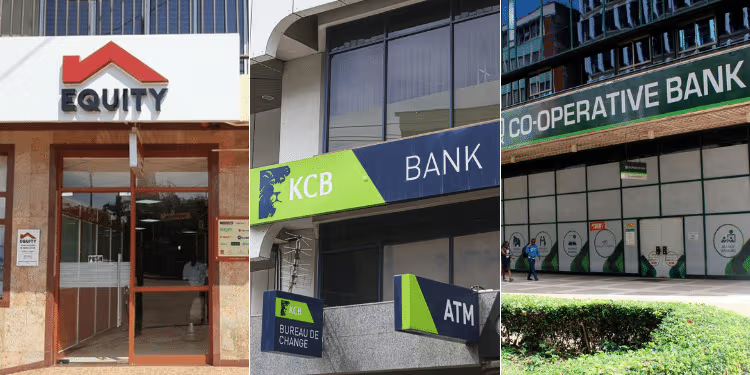
- KCB Group – KES 2.25 Trillion Assets
KCB Group retained its position as the largest financial institution in East Africa by asset size after growing its balance sheet to KES 2.254 trillion in Q1 2026.
The lender has continued expanding aggressively across the region, particularly in the Democratic Republic of Congo through Trust Merchant Bank (TMB). Its strategy combines large-scale corporate lending, infrastructure financing, and heavy allocation into Kenyan government securities.
KCB’s size gives it one of the largest lending capacities in the region, allowing it to participate in syndicated infrastructure projects, energy financing, and public sector transactions across East Africa.
The bank also maintains one of the widest branch and agency banking networks in the region.
- Equity Group Holdings – KES 2.04 Trillion Assets
Equity Group Holdings ranked second with assets of KES 2.036 trillion, remaining one of the most profitable lenders in the market and one of the region’s largest customer-focused banks.
Its regional diversification strategy continues to drive growth, especially through Equity BCDC in the DRC, which has become one of the group’s strongest-performing subsidiaries.
Equity’s low-cost deposit structure, strong mobile banking ecosystem, and extensive retail customer base have helped it maintain strong earnings even as lending conditions remain cautious.
The lender’s microfinance-rooted model has also allowed it to scale rapidly in underserved markets across East and Central Africa.
- Co-operative Bank of Kenya – KES 884.6 Billion Assets
Co-operative Bank of Kenya remained firmly in third position after its asset base expanded to KES 884.6 billion. The lender continues to dominate Kenya’s cooperative movement banking ecosystem, serving SACCOs, agricultural societies, unions, and public sector institutions.
Its long-standing relationships within Kenya’s cooperative sector have given it a highly stable deposit base and consistent earnings performance. The bank also remains one of the sector’s most efficient lenders in terms of cost-to-income management.
- I&M Group – KES 742.5 Billion Assets
I&M Group narrowly moved ahead of NCBA in the race for fourth place after growing its assets to KES 742.5 billion.
Traditionally known as a corporate and high-net-worth lender, I&M has recently accelerated its retail banking expansion through digital products and zero-fee mobile wallet transactions.
The lender also maintains strong trade finance operations and regional hubs in Rwanda and Mauritius, supporting cross-border business flows. Its technology-focused operating model has helped improve efficiency while supporting customer acquisition in the retail segment.
- NCBA Group – KES 741.1 Billion Assets
NCBA Group followed closely behind with an asset base of KES 741.1 billion. The bank remains one of Kenya’s largest digital lending players through its partnership with Safaricom on M-Shwari and related mobile lending platforms.
NCBA has also maintained a strong presence in asset finance, particularly in vehicle financing, logistics equipment, and industrial machinery lending. Its position in corporate banking and digital underwriting continues to support balance sheet growth.
- Diamond Trust Bank – KES 680.9 Billion Assets
Diamond Trust Bank ranked sixth with assets of KES 680.9 billion. The lender has traditionally maintained a conservative banking model focused on SME financing, trade finance, and disciplined risk management.
Its backing by the Aga Khan Fund for Economic Development (AKFED) has continued to support long-term stability and regional growth. DTB has also expanded its branch network across East Africa while maintaining relatively strong asset quality compared to some peers.
- Absa Bank Kenya – KES 571.3 Billion Assets
Absa Bank Kenya posted assets of KES 571.3 billion in Q1 2026. Since rebranding from Barclays, the lender has continued diversifying into wealth management, investment banking, retail lending, and digital financial services.
Its Timiza digital platform remains a major part of its retail banking strategy, alongside increased focus on personal loans and credit card products. Absa also maintains strong international trade banking capabilities through its continental network.
- Stanbic Bank Kenya – KES 551.7 Billion Assets
Stanbic Bank Kenya ranked eighth after growing its asset base to KES 551.7 billion.
The lender remains heavily focused on corporate and investment banking activities, including foreign exchange trading, syndicated financing, and multinational client servicing.
Its connection to South Africa’s Standard Bank Group continues to strengthen its cross-border banking operations and institutional finance capabilities. Stanbic also remains one of the leading arrangers of large corporate transactions in Kenya.
- Standard Chartered Kenya – KES 413.3 Billion Assets
Standard Chartered Kenya closed the top-nine ranking with assets of KES 413.3 billion.
The lender has increasingly shifted away from mass retail banking in favor of affluent banking clients, wealth management, treasury services, and multinational corporate relationships.
Its global custody services and asset management business remain among its strongest divisions. The bank has also maintained relatively lower non-performing loan levels through stricter credit risk management practices.
Why Kenyan Banks Continued Growing in Q1 2026
- Increased Investment in Government Securities
Many lenders increased allocations toward Treasury bills and bonds as private sector credit demand remained relatively cautious. Government paper offered predictable returns with lower default risk compared to unsecured lending.
- Falling Funding Costs
Lower deposit pricing and improved liquidity conditions helped banks widen interest margins. Large banks with strong current and savings account (CASA) deposits particularly benefited from cheaper funding structures.
- Regional Subsidiary Contributions
Banks with operations outside Kenya recorded stronger earnings diversification, especially in the Democratic Republic of Congo, Rwanda, Tanzania, and Uganda. Regional subsidiaries increasingly contributed a larger share of group profitability.
- Digital Banking Growth
Mobile banking, digital loans, agency banking, and app-based transactions continued reducing operational costs while expanding customer reach. Digital banking has also become a major source of fee income across Kenya’s banking sector.
Jefferson Wachira is a writer at Africa Digest News, specializing in banking and finance trends, and their impact on African economies.