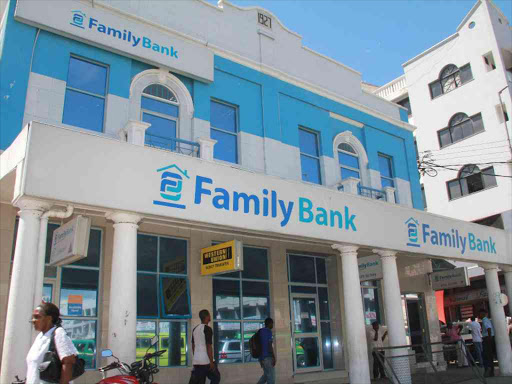
Family Bank Shares Rise 178% on NSE Debut, Valuation Crosses KSh83 Billion

Family Bank made its debut on the Nairobi Securities Exchange (NSE) on Tuesday through a listing by introduction at a reference price of KSh18.00 per share, giving the lender an initial market capitalization of approximately KSh29.9 billion.
The stock rallied strongly during its first day of trading, climbing to KSh50.00 per share, a gain of 177.8% from the introduction price. At that level, the bank’s market capitalization rose to about KSh83 billion, placing it among the most valuable banking counters on the exchange.
Family Bank Lists 1.66 Billion Shares on the NSE
The listing saw 1.66 billion issued ordinary shares admitted to trading under the Main Investment Market Segment (MIMS). Unlike an initial public offering (IPO), a listing by introduction does not involve the issuance of new shares or raising fresh capital.
Instead, existing shareholders gain the opportunity to trade their holdings on the public market.
Family Bank entered the bourse as the 11th largest listed bank by market capitalization based on its reference price.
The move provides liquidity to long-term shareholders, including the Kenya Tea Development Agency (KTDA) and members of the Muya family, while allowing investors to determine the bank’s market value through open-market trading.
Family Bank Valuation Metrics and Dividend Yield
At the introduction price of KSh18.00 per share, Family Bank traded at a price-to-earnings (P/E) ratio of about 4.6 times based on its FY2025 earnings and at a price-to-book (P/B) ratio of approximately 0.9 times, compared with a book value per share of KSh19.62.
The lender also offered a dividend yield of 6.7%, supported by a FY2025 dividend per share of KSh1.20 and a payout ratio of roughly 30.5%.
According to valuation estimates by Standard Investment Bank, Family Bank’s blended fair value stood at KSh29.62 per share using five valuation methodologies. This placed the KSh18.00 introduction price at a discount of approximately 39% to the estimated intrinsic value.
Family Bank Financial Performance and Growth Trends
The bank’s financial performance has strengthened over the past five years. Profit after tax rose from KSh2.4 billion in FY2021 to KSh5.3 billion in FY2025. During the first quarter of 2026, net profit reached KSh1.6 billion, representing a 52.6% increase compared with the same period a year earlier.
Total assets expanded from KSh113.1 billion in 2021 to KSh208.7 billion in 2025 and stood at KSh230.2 billion in the first quarter of 2026, an increase of 32.3% year-on-year.
Customer deposits reached KSh151.9 billion at the end of 2025 and increased to KSh168.9 billion during the first three months of 2026, while shareholders’ funds rose to KSh34.7 billion, up 42.2% year-on-year.
What Investors Need to Know About Family Bank Shares
Investors can only acquire Family bank shares through the secondary market because the listing by introduction did not include a retail subscription period.
Trading volumes in the early weeks may also be influenced by the level of share dematerialization. Prior to the commencement of trading, approximately 34.5% of Family Bank’s ordinary shares had been fully dematerialized into the Central Depository and Settlement Corporation (CDSC) registry.
The lender’s medium-term growth ambitions under its 2025–2029 “Biashara” strategy will unfold against a banking environment characterized by pressure on interest margins, changing monetary conditions, and elevated funding costs across the sector.
Family Bank’s sharp rise on its first trading day suggests investors are willing to assign a premium valuation to the lender, substantially above its reference price, as the market begins determining its long-term position among Kenya’s listed banks.